There are painters who belong entirely to one country, one city, one circle of friends. James Tissot belonged to none of them. Born Jacques Joseph Tissot in Nantes in 1836, the son of a prosperous linen draper and his milliner wife, he would pass his life between two capitals, two languages, two visions of what painting could be. He was French by birth and temperament, English by circumstance and affection, and in the end he became something stranger still — a man seized by religious fervour who abandoned the drawing rooms of London and Paris for the dusty roads of Palestine. · 8 min read
His early promise was unmistakable. By twenty-one he was exhibiting at the Paris Salon. He had studied under Lamothe and Flandrin, inheritors of the Ingres tradition, and their discipline never quite left him — even his most casual compositions are undergirded by a draughtsman’s certainty. But Tissot was restless. The academic world of history painting bored him. He wanted to paint the life he saw around him: the rustling silks, the loaded glances, the social theatre of modern Paris.
Paris and the Commune
In the 1860s, Tissot moved through the artistic circles of Paris with easy confidence. He became close to Edgar Degas, who admired his technical facility and would later try, unsuccessfully, to recruit him for the Impressionist exhibitions. He knew Whistler and Manet. He painted elegant medieval subjects and fashionable genre scenes, building a reputation as a painter of gorgeous surfaces — a man who understood fabric as well as flesh.
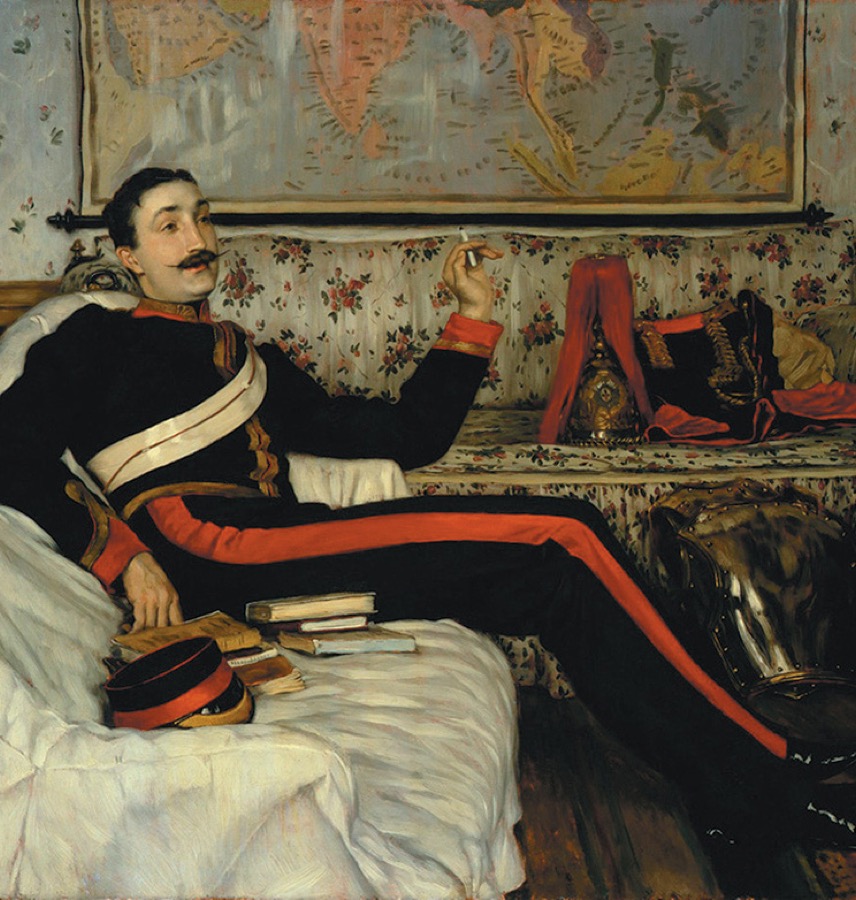
Then came 1871. The Franco-Prussian War had humiliated France, the Second Empire had collapsed, and Paris erupted into the brief, violent experiment of the Commune. Tissot’s precise involvement remains debated. He may have served in the National Guard; he certainly had connections to the Communard cause. When the Commune fell and the reprisals began — when thousands were shot in the streets or deported to penal colonies — Tissot found it prudent to leave France. He crossed the Channel to London, carrying his talent and very little else.
It was the great pivot of his life. What looked like exile became reinvention. London, booming and imperial, offered Tissot something Paris could not: a fresh audience hungry for images of their own splendour.
London Society
Tissot arrived in London in 1871 and within months had established himself as one of the most sought-after painters in the city. The English, who had long imported French taste, were delighted by this Frenchman who could render their world with such loving precision. He set up a grand studio in St John’s Wood, complete with a colonnade and garden that appear again and again in his paintings, and he began to produce the works for which he is best remembered.
These London paintings are extraordinary documents. The Ball on Shipboard (c. 1874) is a dazzling panorama of naval festivity — flags snapping in the breeze, women in white clustered like flowers along the deck, officers in dress uniform threading through the crowd. The composition is almost vertiginous in its complexity, yet every detail is rendered with watchmaker precision. You can practically hear the band playing and the champagne corks popping.
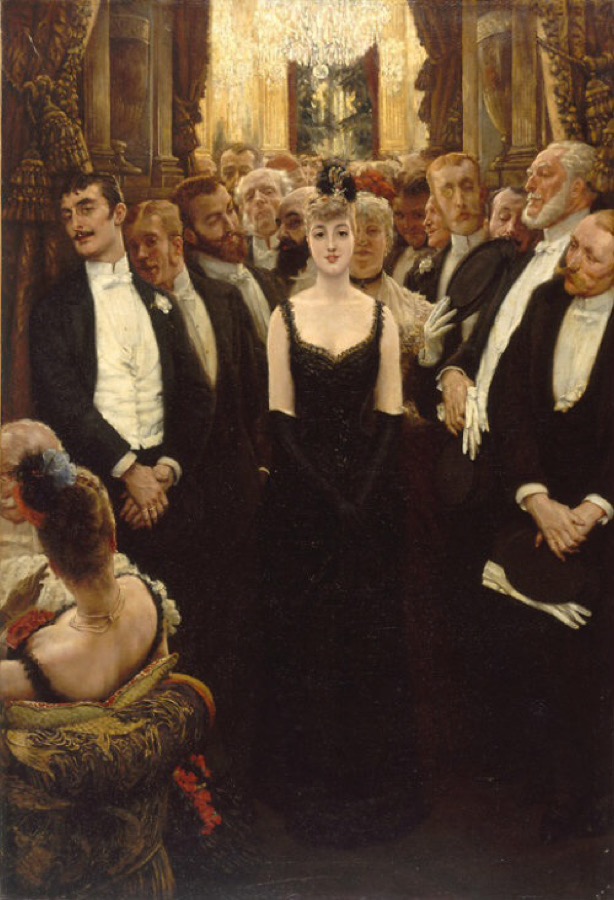
Too Early (1873) captures that excruciating social moment when guests arrive at a party before anyone else. A small cluster of the over-punctual stands awkwardly in a vast ballroom while musicians tune their instruments and servants make final adjustments. It is a painting about embarrassment, about the fragility of social poise, and it is very funny. The Gallery of HMS Calcutta (c. 1876) shows young women lounging on the deck of a warship in Portsmouth harbour, their elaborate dresses a gorgeous counterpoint to the grey naval machinery around them.
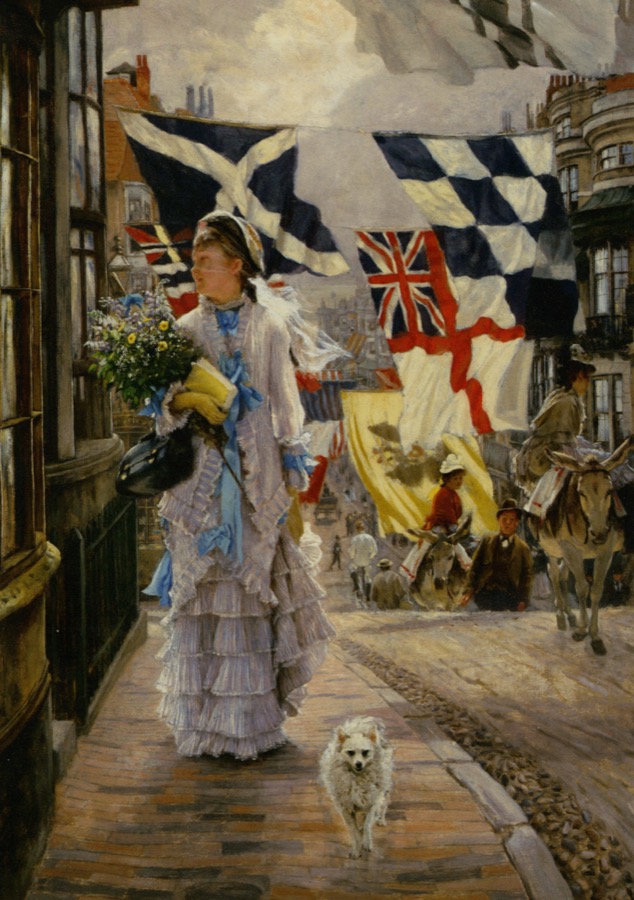
What distinguishes these paintings from mere society illustration is their psychological acuity. Tissot painted Victorian England as only a foreigner could — with the besotted attention of a man who finds everything new and marvellous and slightly absurd. He noticed things the English themselves took for granted: the elaborate semaphore of parasols and fans, the way a woman’s posture could convey invitation or rebuff, the theatrical quality of everyday life in the upper reaches of the world’s greatest empire.
He painted Thames-side scenes — picnics at Henley, boating parties at Maidenhead, promenades along the Embankment — with the golden light and leisured ease of a world that believed it would last forever. These are not nostalgic paintings; they were painted in the present tense. But to our eyes they are saturated with the poignancy of a vanished world, as all great paintings of pleasure eventually become.
Kathleen Newton
In 1876, Tissot met Kathleen Newton, and everything changed. She was twenty-two, Irish-born, beautiful, and scandalous. She had married a surgeon in the Indian Civil Service at seventeen, had an affair during the voyage to India, returned to England pregnant with another man’s child, and been divorced. In the rigid moral architecture of Victorian society, she was ruined. None of that mattered to Tissot. He fell in love with her completely.
Kathleen moved into the St John’s Wood house with her two children, and for the next six years she became the centre of Tissot’s art and life. Her face appears in painting after painting — reading in the garden, reclining on a chaise longue, gazing from a window, strolling through autumn leaves. She is always recognisable: the heavy-lidded eyes, the slightly wistful expression, the sense of a woman who has lived through something and come out the other side with her dignity intact.
These are among Tissot’s most intimate and tender works. The grand social panoramas give way to quieter, more private scenes. The paintings are smaller, warmer, closer. They have the quality of love letters — addressed to one person but eloquent enough to move anyone who sees them.
But Kathleen was ill. She had tuberculosis, the great killer of the nineteenth century, and it was consuming her slowly. Tissot watched her fade. On 9 November 1882, at the age of twenty-eight, she took an overdose of laudanum and died. Whether it was suicide or an accidental overdose of her pain medication remains uncertain. Tissot was shattered. Within days of her death, he closed the St John’s Wood house, packed his belongings, and returned to France. He never lived in England again.
Return to Paris and Religious Art
The Tissot who returned to Paris in 1882 was a changed man. For a time he resumed painting fashionable subjects — the series La Femme à Paris (1883–1885), fifteen large paintings depicting the types of Parisian womanhood, was a commercial success. But something had shifted in him. The death of Kathleen Newton had opened a wound that society painting could not heal.
The transformation came suddenly. In 1886, Tissot experienced what he described as a religious vision while sitting in the church of Saint-Sulpice. He saw Christ and the Magdalene, he said, as clearly as he saw the pillars of the church. From that moment, he devoted the rest of his life to religious art.
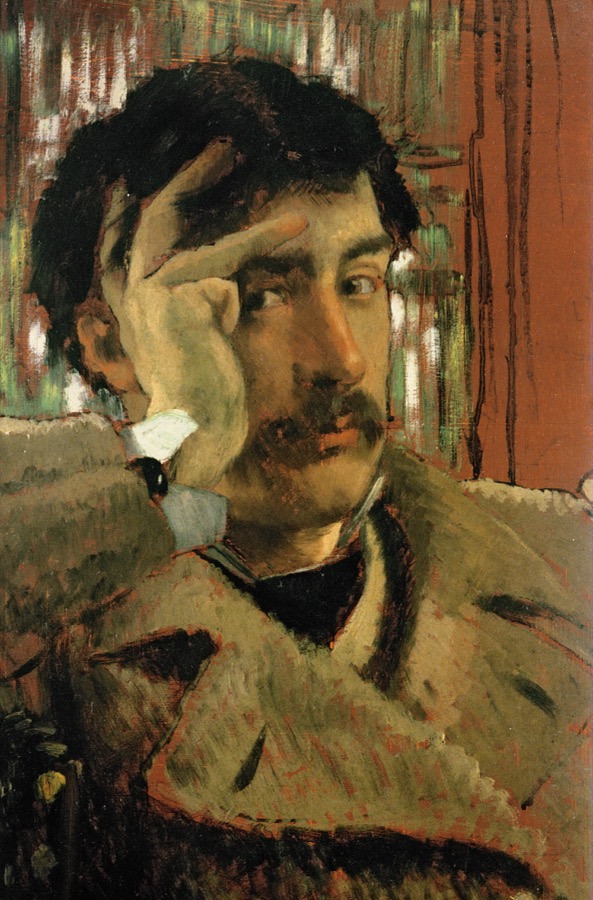
He travelled to Palestine three times between 1886 and 1896, sketching landscapes, studying architecture, observing local customs. The result was a monumental series of 350 watercolour illustrations of the Life of Christ, exhibited in Paris in 1894 to enormous public acclaim. The paintings are remarkable — vivid, archaeologically meticulous, and painted with the same obsessive attention to costume and setting that had made his society pictures so compelling. Christ walks through a Palestine that looks like Palestine, not like Renaissance Italy. The crowds wear the garments Tissot had sketched from life in Jerusalem and Galilee.
He followed this with an equally ambitious Old Testament series, which occupied him until his death at his family’s château in Buillon on 8 August 1902. He was sixty-six.
Legacy
Tissot’s reputation has waxed and waned with the tides of taste. For much of the twentieth century, he was dismissed as a mere illustrator, a painter of pretty dresses with nothing beneath the silk. The Impressionists, who were his contemporaries and in some cases his friends, overshadowed him completely. Degas’s greatness made Tissot look lightweight. Monet’s revolution made Tissot look conservative.
But taste has circled back. Since the 1980s, Tissot has been rediscovered and reassessed. Major exhibitions at the Barbican in London, the Musée d’Orsay in Paris, and museums across America have revealed an artist of far greater depth and complexity than the old dismissals allowed. His paintings are now understood not as superficial records of fashion but as penetrating studies of social performance — the masks people wear, the roles they play, the gap between appearance and feeling.
He remains an artist between worlds — French and English, secular and sacred, a society painter who became a pilgrim, a man of surfaces who was searching, always, for what lay beneath. His London paintings preserve a vanished world with a vividness that photography, still in its infancy, could not match. His portraits of Kathleen Newton are among the most moving love paintings of the nineteenth century. And his religious works, whatever one makes of the conversion that inspired them, represent a staggering feat of devotion and draughtsmanship.
James Tissot painted the world as he found it — gorgeous, transient, and haunted by the suspicion that there must be something more. That he found that something, or believed he did, in the churches of Paris and the hills of Palestine, only deepens the mystery of a life lived between two countries, two centuries, and two visions of what it means to see.