A wealthy state with close political ties to the neighboring Benin kingdom, Owo was famed for the virtuosity of its ivory carvers. Located on the eastern edge of Yorubaland, Owo is almost equidistant from Benin and Ife, the Yoruba cultural and religious center from which the reigning dynasty in Benin traces its origin. Although some Owo artworks resemble the highly naturalistic brass and terracotta sculptures of Ife, the regalia of Owo’s kings and chiefs is most like that of their counterparts in Benin. · 7 min read
The influence of Benin royal art is particularly apparent in Owo, a Yoruba kingdom that came under Benin control in the fifteenth century and again in the eighteenth. Owo rose to regional prominence in the eighteenth century through trade and conquest, and became one of the largest states in West Africa at that time.
- Source:
- The Metropolitan Museum of Art (MET)
- Culture:
- Yoruba peoples, Owo group
- Date:
- 17th–19th century
- Medium:
- Ivory, wood or coconut shell inlay
- Credit Line:
- Gift of Mr. and Mrs. Klaus G. Perls, 1991
- Object Number:
- 1991.17.123
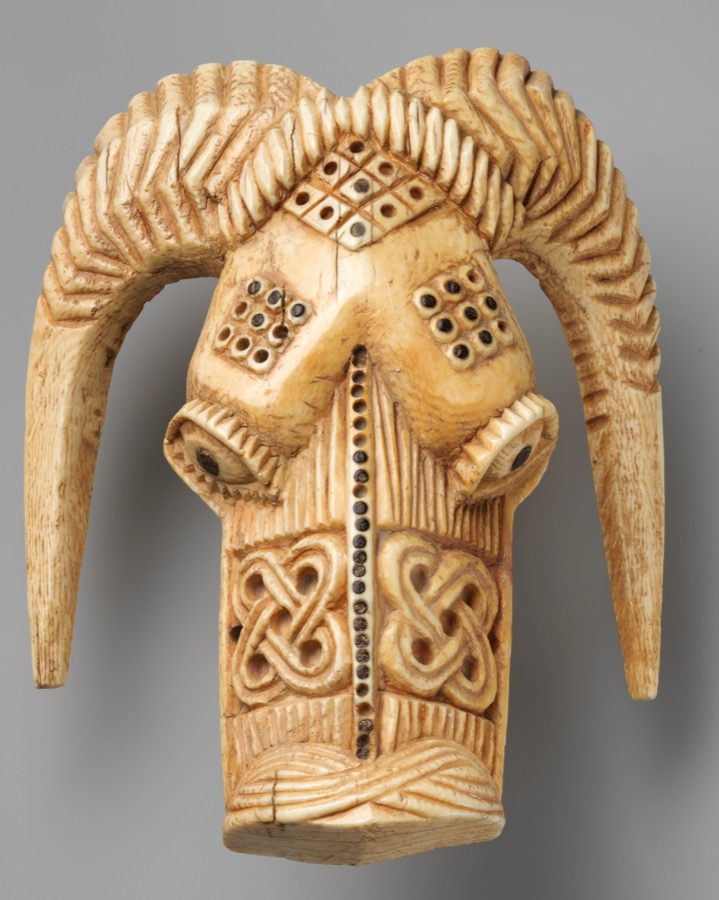
This diminutive ivory ram’s head constituted part of the courtly regalia of an olowo, the ruler of the Yoruba state of Owo in southern Nigeria. It was created as a decorative element of an orufanran, a type of ceremonial ensemble worn by the olowo and high-ranking chiefs during state ceremonies. Consisting of a bulky coat or shirt covered in red flannel scales, the orufanran was studded with ivory images of human faces and the heads of crocodiles, leopards, and rams. The outfit relates to the chief’s military duties, and it is no coincidence that the animals depicted are those characterized by their strength and ferocity.
Despite its small size, this ram’s head is richly embellished with intricate incised designs and dark inlaid wood. Its aesthetic impact relies on a sophisticated interplay of bare and adorned surfaces. While the muzzle is dominated by linear grooves and quatrefoil knots — a motif used extensively in Yoruba art — the forehead presents broad passages of flat surface interrupted by diamonds of squares and circles. The interaction of opposing surfaces continues along the spreading horns that frame the ram’s face. Deep ridges on the horns’ base balance the smooth forehead, while the unadorned tips offset the elaborate motifs on the muzzle.
Udàmalóre — Ceremonial Swords
- Source:
- The Metropolitan Museum of Art (MET)
- Geography:
- Nigeria, Ijebu-Owo. Ondo State
- Culture:
- Yoruba
- Medium:
- Ivory, wood or coconut shell inlay
- Dimensions:
- W. 5 × D. 2 × L. 19¼ in. (12.7 × 5.1 × 48.9 cm)
- Credit Line:
- Gift of Mr. and Mrs. Klaus G. Perls, 1991
- Object Number:
- 1991.17.122
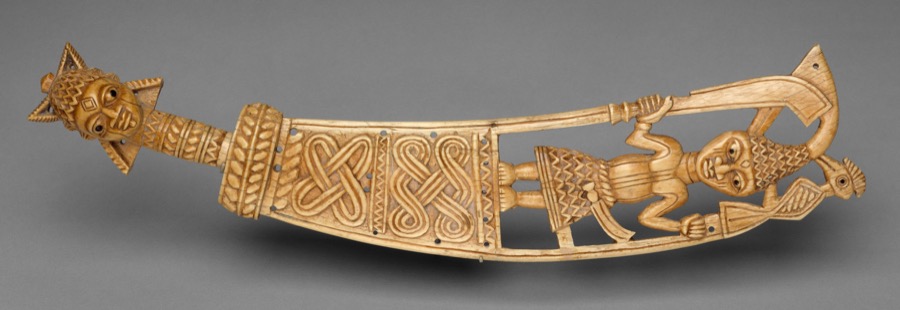
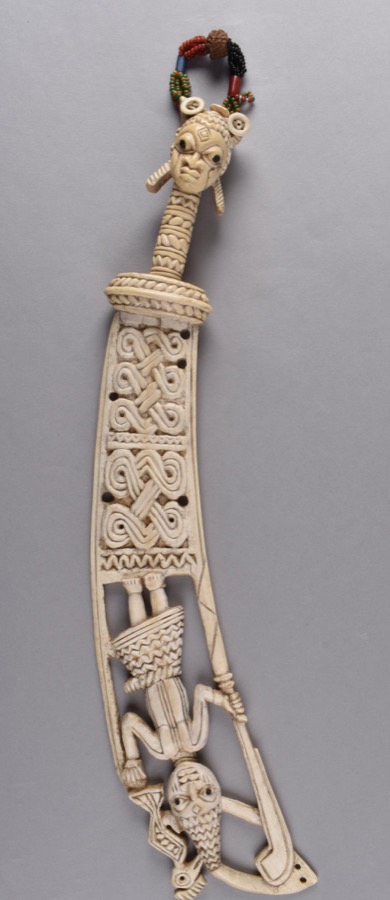
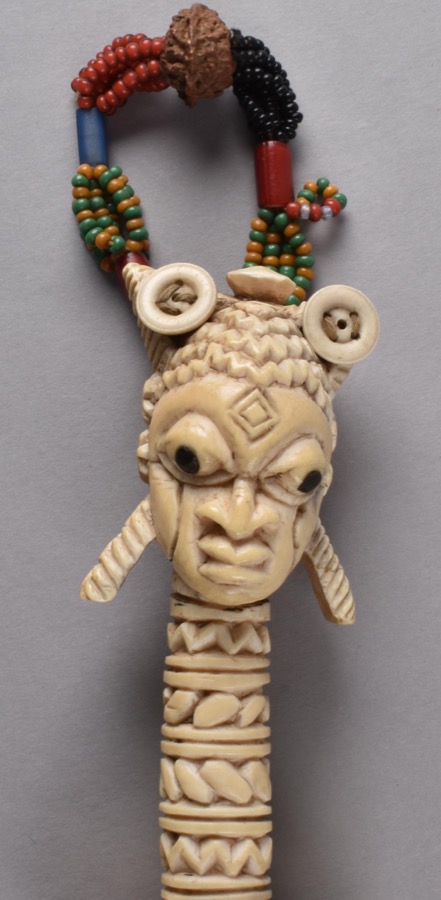
This opulent ivory sword is an udamalore, literally a “sword of the well-born.” It was carried by a high-ranking chief of Owo, a Yoruba state in present-day Nigeria that rose to regional power in the eighteenth century. Worn on the hip, it indicated the power and status of its bearer at public ceremonies and celebrations.
Consisting of a figurative handle and a curved, openwork blade, this udamalore is a stunning example of the works created at this celebrated ivory-carving center. The human head that constitutes the pommel displays a delicate coiffure of repeated chevrons, while the eyes are augmented with dark inlaid wood. The solid base of the blade is decorated with two knot patterns, while the openwork section depicts an Owo chief in ceremonial dress, wearing his own udamalore horizontally on the left hip.
The upraised sword is an uda, used in combat, while the bird refers to the protective spiritual power associated with elderly Yoruba women. In combination, these emblems suggest a ruler who is physically and spiritually equipped to face all the challenges he may confront.
- Source:
- British Museum
- Registration:
- Af,+.897
- Dimensions:
- Height: 51.20 cm, Width: 10.10 cm, Depth: 5.50 cm
- Materials:
- Ivory
- Made by:
- Yoruba, Owo
- Acquisition:
- Given to the BM by A. W. Franks on 1 October 1878, from a collection formed by John Dumaresq, Administrator of Lagos 1874–1878
Orufanran Costume Attachments
Owo is renowned for its ivory carving, and many of the ivory ornaments and cups made for Owo’s rulers are similar in form or imagery to objects from Benin. The highest-ranking chiefs of Owo used ivory costume elements to demonstrate their exalted status. An interest in pattern and texture is seen in the many ivory ornaments attached to the Owo rulers’ opulent ceremonial costumes. They portray animal heads and human figures and are often inlaid with dark wood or coconut shell to emphasize their boldly incised designs.
- Source:
- The Metropolitan Museum of Art (MET)
- Culture:
- Yoruba peoples, Owo group
- Date:
- 17th–19th century
- Source:
- The Metropolitan Museum of Art (MET)
- Medium:
- Ivory, wood or coconut shell inlay
- Dimensions:
- H. 5½ × W. 2 3/16 × D. 1½ in. (14 × 5.6 × 3.8 cm)
- Credit Line:
- Gift of Mr. and Mrs. Klaus G. Perls, 1991
- Object Number:
- 1991.17.125
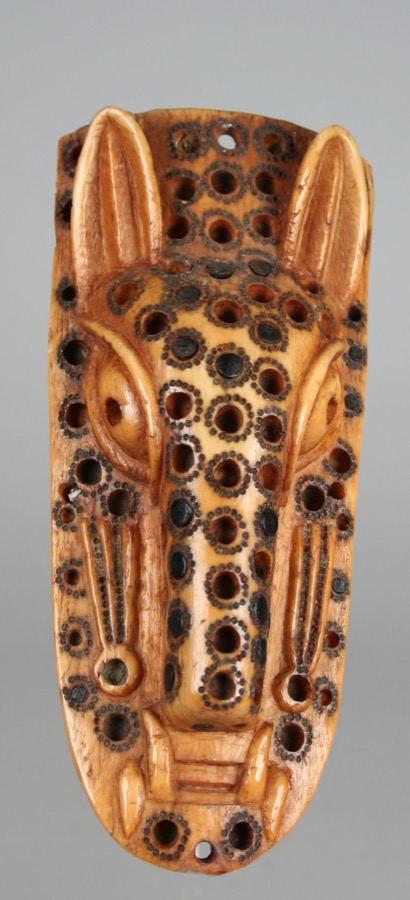
Among the Owo-Yoruba, a red costume (orufaran) is worn by the highest ranking chiefs as a privilege granted by the king (olowo). It consists of a top shirt made of imported red flannel that is scalloped to resemble the scales of an anteater or pangolin. Like the scales of a pangolin, the costume protects its wearer from harm by rendering him invulnerable. Sewn onto the scalloped shirt are a series of carved ivory ornaments (omama) depicting powerful animals such as the ram, crocodile, leopard, or horse.
Lidded Vessels & Cups
- Source:
- The Metropolitan Museum of Art (MET)
- Culture:
- Yoruba peoples, Owo group
- Medium:
- Ivory, wood or coconut-shell inlay
- Dimensions:
- H. 8¼ × W. 4¾ × D. 4⅝ in. (21 × 12.1 × 11.7 cm)
- Credit Line:
- Gift of Mr. and Mrs. Klaus G. Perls, 1991
- Object Number:
- 1991.17.126a, b
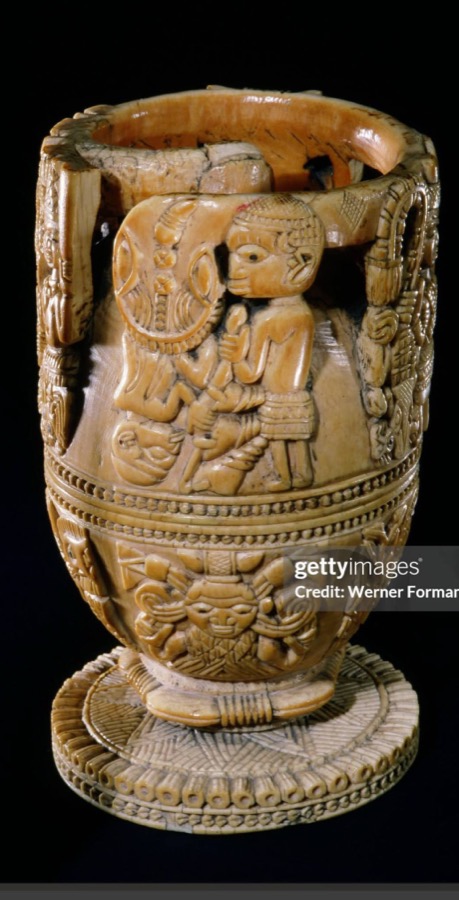
This spectacular ivory vessel was once the treasured possession of an olowo, the ruler of the Yoruba kingdom of Owo in present-day southern Nigeria. Much of Owo’s courtly culture, including titles, costumes, and prestige sculpture, reflect a close association between Owo and Benin, two important political and cultural centers.
Prominent and pervasive mudfish and crocodile motifs evoke the king’s praise names, or oriki, that liken him to a vast ocean into which all rivers flow and whose unfathomable depths hold potent secrets and supernatural abilities. It also emphasizes the king’s intimate relationship with Olokun, god of the sea, who brings wealth and fertility to his adherents. The imagery inscribed throughout the surface of this vessel suggests the olowo’s ability to span multiple realms — terrestrial and aquatic, human and divine.
- Source:
- British Museum
- Registration:
- Af1976,05.1.a-b
- Dimensions:
- Diameter: 12 cm, Height: 21.50 cm, Width: 13.50 cm
- Materials:
- Ivory
- Production place:
- Owo, Ondo State, Nigeria
- Description:
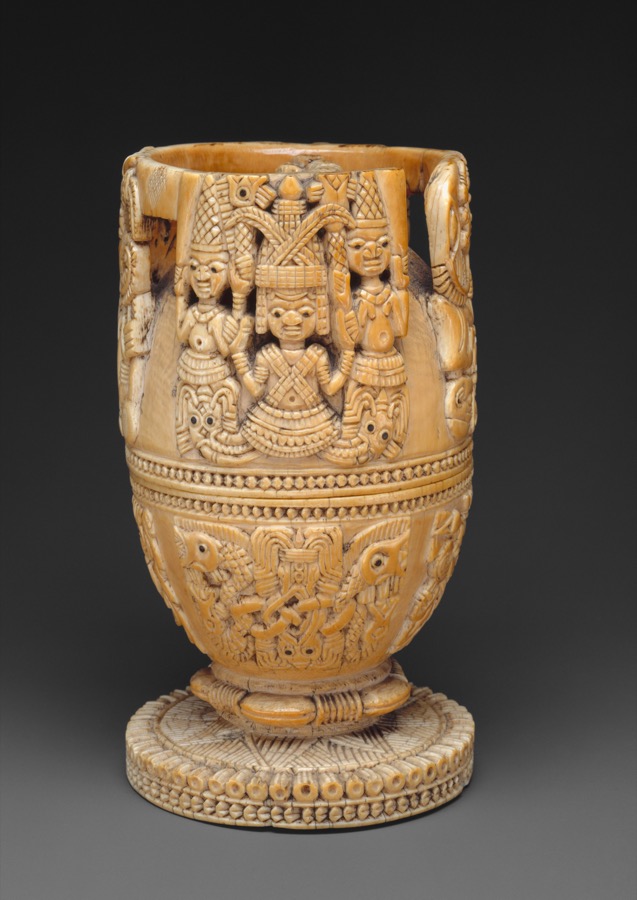
- Bowl and lid carved with animal motifs: two monkeys eating fruit from a branch; antelope eating a leaf; double headed mudfish with inlaid metal eyes; crested bird with head turned back
- Previous owner:
- James Hooper. Purchased at Christie’s, 14 July 1976, lot 52, for £300
- Source:
- British Museum
- Registration:
- Af1929,-.30
- Dimensions:
- Diameter: 16.30 cm, Height: 23.70 cm, Width: 15 cm
- Materials:
- Ivory, pewter
- Production:
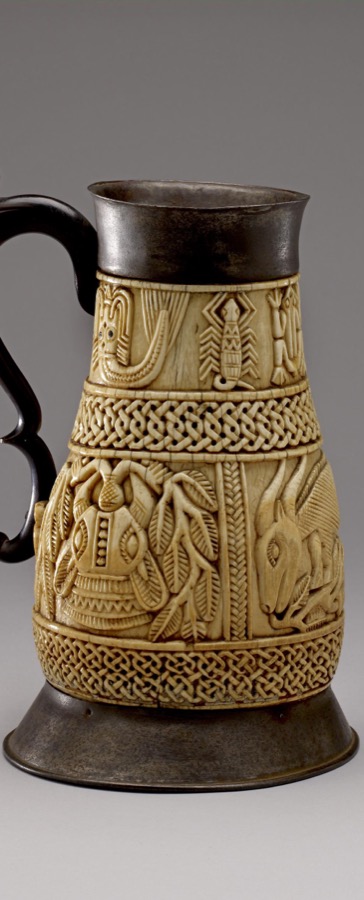
- Yoruba, Owo (probably). The ivory carving is Nigerian; the pewter mounts are European, probably added in England in the later 18th century.
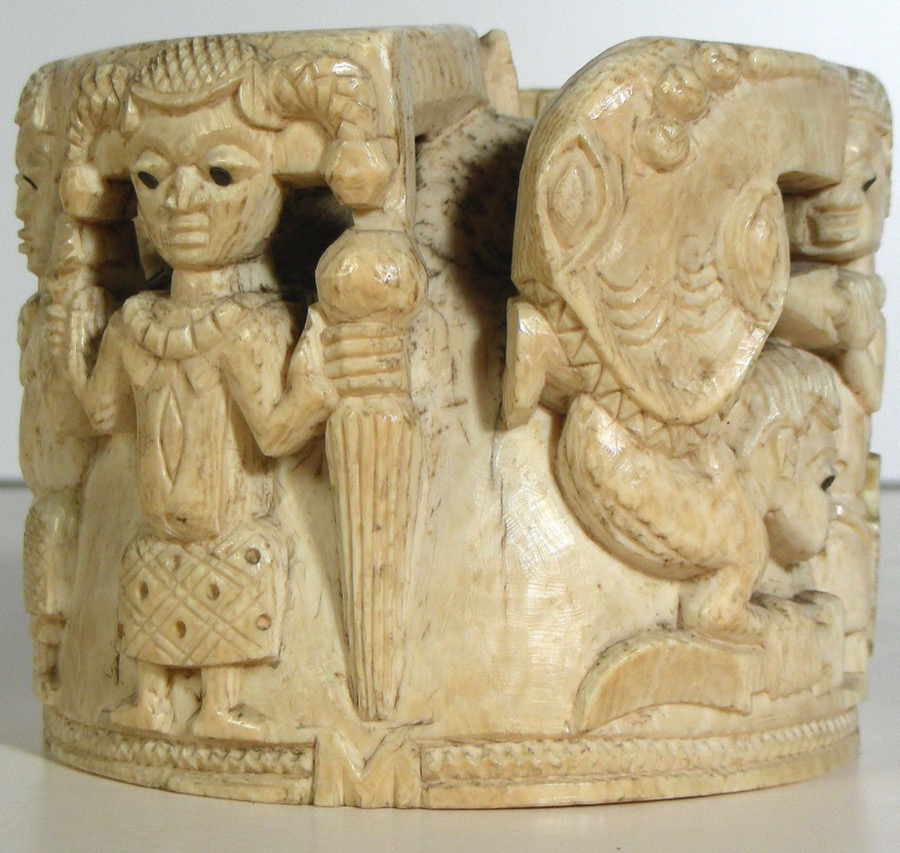
- Source:
- British Museum
- Registration:
- Af1878,1101.327
- Dimensions:
- Diameter: 11.50 cm, Height: 11.50 cm
- Materials:
- Ivory
- Production place:
- Owo, Ondo State, Nigeria
- Acquisition:
- Meyrick collection, formed by Sir Samuel Rush Meyrick (1783–1848), given to the BM in 1878 by his heir Augustus William Henry Meyrick