The Solomon Knot — an ancient interlace motif consisting of two closed loops doubly interlinked in a symmetrical form — appears across an astonishing range of human cultures: Roman mosaics, Viking runestones, Coptic textiles, medieval Italian pavements, and the illuminated manuscripts of the British Isles. Yet nowhere does this universal emblem appear with greater frequency, sophistication, or cultural tenacity than in the artistic traditions of the Yoruba people of southwestern Nigeria. From the terracotta heads of ancient Ife to the brass plaques of Benin, from the ivory carvings of Owo to the embroidered caps of contemporary politicians, the Solomon Knot and its related interlace patterns form a continuous thread through more than eight centuries of Yoruba visual culture. This essay — the first in a series on the artistic history of the Yoruba people — traces the origins and evolution of this motif across the three great artistic centers of Ife, Benin, and Owo, and argues that its persistence reveals something fundamental about the Yoruba understanding of power, beauty, and the sacred. · 13 min read
The interlace pattern, in its simplest form, is a line that crosses over and under itself or other lines to produce a woven effect. The Solomon Knot is the most elemental of these interlace forms: two loops, each passing through the other twice, creating a motif of unbroken continuity. In Yoruba art, this basic unit is elaborated into quatrefoil knots, guilloche bands, chain-link borders, and complex fields of interlocking geometry that cover entire surfaces with a density and precision that astonishes the modern eye. The question of where this tradition began — and how it traveled between the kingdoms of the Yoruba world — is one of the most compelling in African art history.
Ife & Benin — Origins and Influence
The city of Ife, known to its inhabitants as Ile-Ife (“the house of expansion” or “the place of origin”), occupies a singular position in Yoruba cosmology. It is regarded as the cradle of human civilization — the spot where the god Oduduwa descended from heaven to create the earth and establish the first kingdom. This is not merely myth: archaeological evidence confirms that Ife flourished as a major urban and artistic center from at least the eleventh century through the fourteenth, producing a body of sculpture that, when it first became known to the wider world in the early twentieth century, overturned every European assumption about the capabilities of sub-Saharan African art.
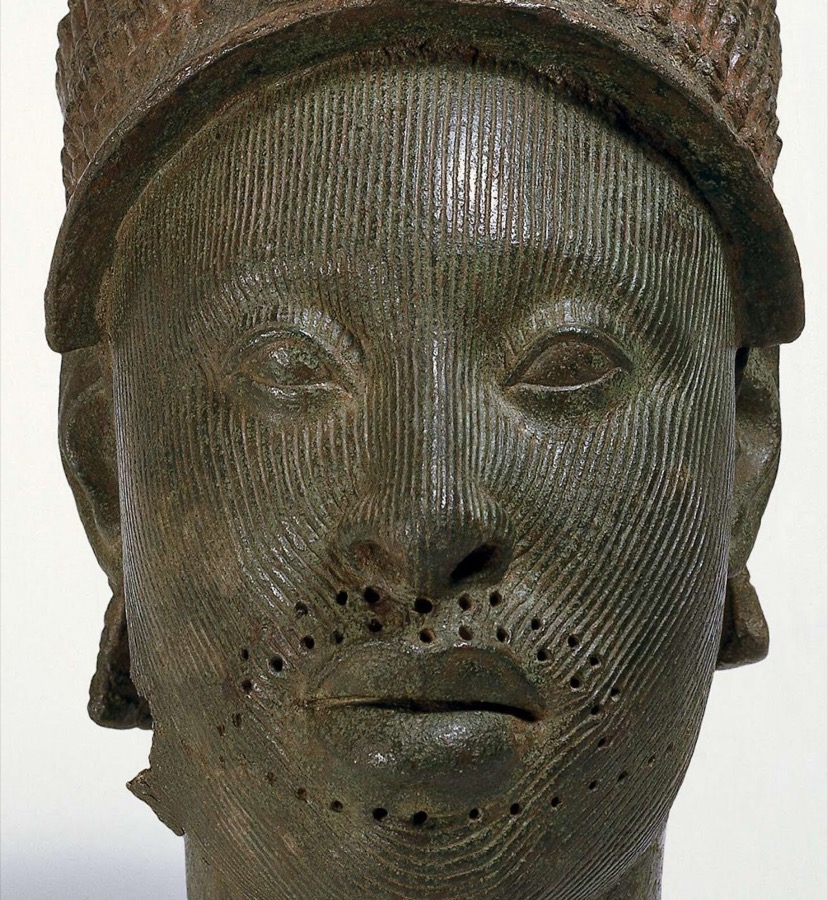
- Source:
- British Museum
- Culture:
- Yoruba peoples, Ife
- Date:
- 12th–14th century
- Medium:
- Brass, lost-wax casting
- Significance:
- Among the finest examples of Ife naturalistic portraiture in brass
The Ife bronzes — more properly brasses, as most are copper alloys rather than true bronze — were produced using the lost-wax (cire perdue) technique, in which a wax model is encased in clay, heated until the wax melts away, and the resulting mold filled with molten metal. The technical mastery required for this process is formidable, and the Ife artists achieved a level of refinement that has rarely been equaled anywhere in the world. The portrait heads, with their serene expressions, delicate striations representing scarification patterns, and idealized naturalism, represent the apex of a tradition that would profoundly influence all subsequent Yoruba art.
It is on these Ife works that we find some of the earliest instances of interlace patterns in Yoruba art. The crowns and regalia depicted on the portrait heads feature bands of interlocking geometric motifs — including forms recognizable as Solomon Knots — rendered with exquisite precision in the metal surface. The terracotta sculptures of Ife, which survive in greater numbers than the bronzes, show similar decorative programs: interlace borders on garments, knotwork patterns on headdresses, and quatrefoil motifs on ritual objects. These are not merely decorative; in Yoruba thought, the knot is a symbol of binding power, of the connection between the visible and invisible worlds, of the authority that holds a kingdom together.
The relationship between Ife and Benin is one of the most important in West African history. According to Benin oral tradition, the Edo people of Benin grew dissatisfied with the rule of their own kings (the Ogisos) and sent emissaries to the Ooni of Ife requesting a new ruler. The Ooni sent his son, Prince Oranmiyan (also written Oranyan), who traveled to Benin City and established a new dynasty circa 1300. Although Oranmiyan himself eventually returned to Yorubaland — reportedly declaring Benin a “land of vexation” — his son Eweka became the first Oba of the present Benin dynasty, a lineage that continues to this day.
The implications of this dynastic connection for the history of art are profound. When the Benin kingdom began to develop its own tradition of brass casting, it drew directly on Ife expertise. Benin tradition holds that the Oba Oguola, who reigned in the late thirteenth or early fourteenth century, sent to the Ooni of Ife requesting a master brass-caster. The Ooni sent Iguegha, who is remembered as the founder of the brass-casting guild in Benin. From this point forward, the artistic traditions of Ife and Benin were inextricably linked — and the interlace motifs that adorned Ife sculpture began their migration into the visual vocabulary of the Benin court.
The Portuguese Encounter
In 1485, Portuguese explorers under the command of João Afonso d’Aveiro became the first Europeans to reach Benin City. What they found astonished them. The city was vast, well-ordered, and prosperous, with broad streets, large houses, and an elaborate palace complex that rivaled anything in contemporary Europe. The Dutch writer Olfert Dapper, compiling Portuguese accounts in 1668, described the city in terms that suggest a metropolis of remarkable sophistication:
At its height around 1500, the Kingdom of Benin was one of the most powerful states in West Africa. Its authority extended from the Niger delta in the east to Lagos in the west, encompassing a vast territory that included numerous Yoruba, Edo, and other communities. The Portuguese established a trading relationship with Benin that lasted more than a century, exchanging brass manillas (horseshoe-shaped ingots used as currency), coral beads, cloth, and firearms for pepper, ivory, and enslaved people. The influx of European brass provided Benin artists with an abundant supply of raw material, fueling an extraordinary expansion of court art production.
It was during this period of growth and cultural confidence that the Solomon Knot motif became deeply embedded in Benin artistic practice. The Portuguese encounter did not introduce the pattern — it was already present, inherited from Ife — but the expanded production of brass artworks in the sixteenth and seventeenth centuries meant that the motif was reproduced on an unprecedented scale, appearing on everything from altar pieces and commemorative heads to the famous brass plaques that once decorated the pillars of the royal palace.
The Solomon Knot in Benin Art
The Solomon Knot appears in Benin art across a wide range of media and periods, but certain categories of objects display the motif with particular prominence. Among the most striking are the rattle staffs (ukhurhe), ceremonial objects used in the worship of ancestral spirits. These tall, slender staffs, typically cast in brass, are surmounted by figurative or abstract finials and decorated along their shafts with bands of interlace patterns, including Solomon Knots, guilloche borders, and complex knotwork fields.
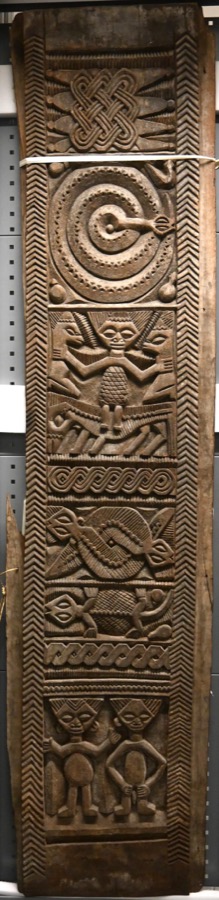
- Source:
- The Metropolitan Museum of Art (MET)
- Culture:
- Edo peoples, Court of Benin
- Date:
- 16th century
- Medium:
- Brass
- Classification:
- Ceremonial / ritual object
The early rattle staffs of the sixteenth century show the Solomon Knot in its most confident and elaborate forms. The interlace bands are deeply carved, the crossings precisely rendered, the overall effect one of rhythmic complexity that transforms a functional ritual object into a work of high art. These staffs were placed on ancestral altars and struck during ceremonies to summon the spirits of deceased obas and chiefs. The Solomon Knot, with its unbroken, interlocking loops, was an apt symbol for the connection between the living and the dead — a visual metaphor for the continuity of the royal lineage.
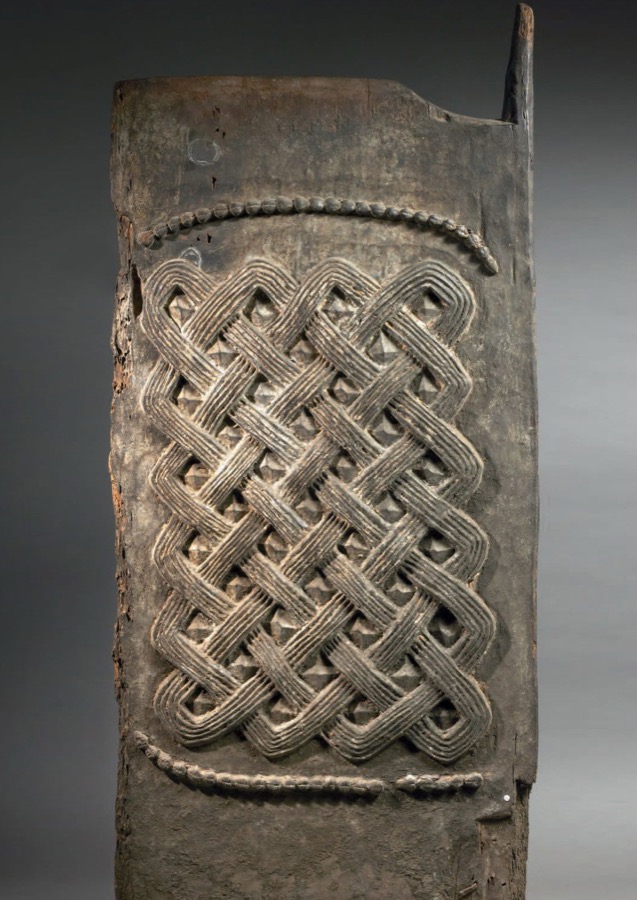
- Source:
- British Museum
- Culture:
- Edo peoples, Court of Benin
- Date:
- 18th century
- Medium:
- Brass
- Function:
- Used on royal ancestral altars during commemorative ceremonies
By the eighteenth century, the Solomon Knot had become a ubiquitous element of Benin court art. Altar bells — conical or cylindrical bells placed on royal shrines alongside rattle staffs, commemorative heads, and carved ivory tusks — display the motif with particular frequency. On these objects, the interlace pattern often fills broad horizontal bands that encircle the bell’s body, alternating with bands of figurative imagery depicting the oba, his warriors, and the animals (leopards, mudfish, pythons) that symbolize royal power. The contrast between the geometric precision of the knotwork and the narrative energy of the figurative scenes creates a visual dialogue between the abstract and the representational, the eternal and the historical — a dialogue that is characteristic of Benin art at its finest.
The prevalence of the Solomon Knot in Benin art raises a question that has occupied scholars for more than a century: did this motif originate in Benin, or was it inherited from Ife? The dynastic and artistic connections between the two kingdoms make the answer almost certain, but it is worth examining the evidence in detail, for it illuminates not only the history of a single decorative pattern but the broader dynamics of artistic influence across the Yoruba world.
The Solomon Knot in Yoruba Art
The evidence for the Ife and broader Yoruba origins of the Solomon Knot motif is compelling. Perhaps the most revealing single object is a terracotta ram’s head from Ife, now in the collection of the National Museum, Lagos. This small but remarkable sculpture, dating to the classical Ife period (twelfth to fourteenth century), displays on its muzzle and forehead a pattern of interlocking quatrefoil knots — Solomon Knots — rendered with the same precision and sophistication that characterizes the finest Ife metalwork. The presence of this motif on an Ife terracotta that predates the earliest known Benin examples by at least two centuries strongly suggests that the Solomon Knot was part of the Ife artistic vocabulary before it traveled to Benin with the brass-casters and cultural practices that accompanied the founding of the new dynasty.
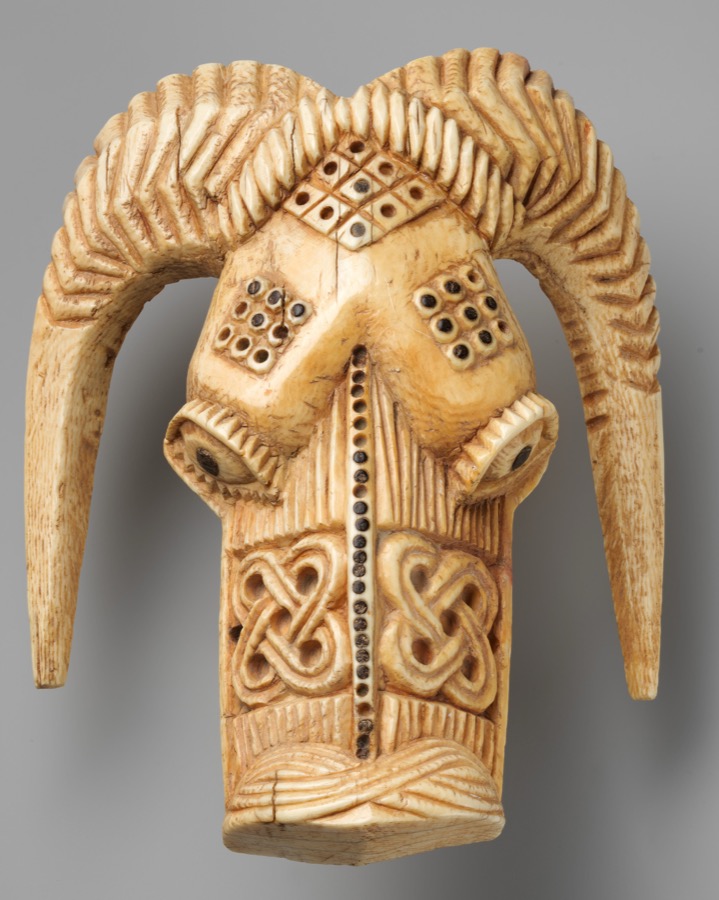
- Source:
- National Museum, Lagos
- Culture:
- Yoruba peoples, Ife
- Date:
- 12th–14th century
- Medium:
- Terracotta
- Significance:
- Among the earliest known examples of the Solomon Knot motif in Yoruba art
The ram itself is a potent symbol in Yoruba culture. Together with the elephant, it is the most important totem among the Yoruba, signifying preeminent power and an aggressiveness that tolerates no rival. The decision to adorn a ram’s head with Solomon Knot patterns was not arbitrary: it united the animal symbol of royal power with the geometric symbol of binding authority and spiritual connection, creating an object of concentrated meaning.
The ivory carvers of Owo, the Yoruba kingdom situated between Ife and Benin, provide further evidence of the deep Yoruba roots of the interlace tradition. The famous Orufanran costume attachment in the form of a ram’s head, now in the Metropolitan Museum of Art, is one of the finest examples of Owo ivory carving to survive. Its muzzle is dominated by “quatrefoil knots — a motif used extensively in Yoruba art,” as the Met’s own catalogue notes, while the forehead presents contrasting passages of flat surface interrupted by diamonds of squares and circles. The sophistication of the carving and the confident deployment of the interlace motif suggest a tradition of long standing — not a recent borrowing from Benin, but an inheritance from the common Ife source.
In the nineteenth and twentieth centuries, the Solomon Knot and its related interlace patterns proliferated across virtually every medium of Yoruba artistic production. Wood carvers incorporated the motif into house posts, doors, and divination boards. Textile workers wove interlace patterns into aso oke cloth. Beadworkers embroidered the pattern onto royal crowns and regalia. Brass-casters in Ijebu and other Yoruba towns produced ritual objects adorned with knotwork borders. The sheer abundance of the motif in later Yoruba art — appearing copiously and across all media — argues for indigenous origins rather than external introduction. A pattern borrowed from a neighboring kingdom might appear occasionally and in limited contexts; a pattern that saturates an entire visual culture is almost certainly homegrown.
The direction of influence, then, appears clear. The Solomon Knot originated in the artistic workshops of ancient Ife, where it was applied to terracotta and brass sculpture as early as the twelfth century. When Ife artists and cultural practices traveled to Benin with the founding of the new dynasty around 1300, the motif traveled with them, becoming integrated into the visual language of the Benin court. From Benin, reinforced by ongoing cultural exchange, the pattern circulated back through the Yoruba world, where it was elaborated and adapted by the carvers of Owo, the weavers of Ilorin, and the beadworkers of Ekiti. By the nineteenth century, it had become one of the most recognizable and pervasive elements of a pan-Yoruba aesthetic — a visual signature of Yoruba identity itself.
The Living Tradition
Perhaps the most remarkable aspect of the Solomon Knot tradition is not its antiquity but its vitality. Unlike many motifs that belong to the sealed past of museum collections and archaeological reports, the Solomon Knot remains a living element of Yoruba visual culture in the twenty-first century. It appears on contemporary textiles, architectural ornament, and decorative arts produced throughout Yorubaland and the Yoruba diaspora. But its most visible and politically charged modern incarnation is one that would have been difficult to predict: the embroidered cap of the President of the Federal Republic of Nigeria.
President Bola Ahmed Tinubu, who assumed office in May 2023, has made the Solomon Knot a personal trademark. His signature fila — the traditional Yoruba cap that is an essential element of male formal dress — features prominent interlace embroidery in the Solomon Knot pattern, rendered in white or silver thread against the cap’s fabric. This is not a generic decorative choice. In a culture where the style, color, and ornamentation of a man’s cap communicate his identity, status, and allegiances, Tinubu’s consistent use of the Solomon Knot motif is a deliberate statement of cultural rootedness and traditional authority. It connects the wearer to the artistic legacy of Ife, to the courtly traditions of the Yoruba kingdoms, and to the deep symbolic resonance of the knot as an emblem of binding power.
The journey of the Solomon Knot from the terracotta workshops of twelfth-century Ife to the presidential villa in twenty-first-century Abuja is a story that spans nearly a millennium. It is a story of artistic transmission across kingdoms, of motifs that survive the rise and fall of empires, of patterns that adapt to new media and new contexts while retaining their essential form and meaning. The Solomon Knot endures because it speaks to something permanent in Yoruba culture — a conviction that power must be bound and channeled, that beauty resides in complexity and precision, and that the past is never truly past but continues to pattern the present.
In the essays that follow, we will trace the broader artistic history of the Yoruba people through the major categories of their creative production: the bronzes and terracottas of Ife, the ivory carvings of Owo, the textiles and beadwork of the nineteenth century, and the modern and contemporary art that carries these traditions into the future. The Solomon Knot will appear again and again in these pages — on crowns and swords, on doors and drums, on cloth and ceramic — a constant thread woven through the fabric of one of the world’s great artistic civilizations.